Seb McLauchlan
Studio
Seb McLauchlan was born in Hong Kong, raised in New Zealand, studied in Wellington and has designed some pretty ace typefaces through Dinamo. We talk through body language at pubs, the importance of questioning the teaching you’re getting at University to how being rejected for a dream job kinda changed everything for the best.
There was the box set DVD of Lord of the Rings, with five or six hours of behind-the-scenes footage. It went deep into production design, art direction, concept art and prop making and was full of professionals talking about their craft and discussing how they developed a design language for the different races in Middle-earth. The elves were going to be Art Nouveau, the dwarves were about geometry, and the orcs were about chaos. It gave me a little bit of an idea about what process meant within design.
I was also really interested in drawing and making things; my dad had a good friend who was a successful brand designer (he designed the HSBC logo) and suggested graphic design might be my thing. It opened up the idea that I could interact with the world through this thing called design, and perhaps be involved in big companies through this one day. I walked into Massey with my portfolio convinced that I was going to be a big branding guy!
:quality(82)/media/sebdvd.jpg)
:quality(82)/media/hsbc.jpg)
A lot of the people who I graduated with had a single-minded goal that after Massey they would get a job at Wētā Workshop. One of the most talented designers I have ever met was at uni, Reuben Smith who joined Wētā straight after study. He was unbelievable and basically taught the whole digital design class, and at 20 knew more than some of the tutors. He just chipped away and learned programs like Maya and ZBrush all in his own time out of class.
:quality(82)/media/reuben.jpeg)
I wanted to make T‑shirts, and one of the earliest briefs I worked on was for a sneaker blog, where if your T‑shirt was chosen it got printed. I didn’t even know what Illustrator was or that you could draw vectors, so I just stuck to Photoshop and would sit with the lasso tool, drawing shapes and not really knowing what I was doing.
:quality(82)/media/sebpicture.jpeg)
:quality(82)/media/seb_tamaki.jpg)
Nah, I don’t think I’ve ever won a design competition. I don’t think I’ve ever won anything!
My parents moved around a lot overseas, and I had about three years without them at boarding school, hanging out with grandparents during the weekends, and I really missed my parents a lot. When they ended up moving back to Wellington, I wanted to spend more time with them, so I went to Massey. I think if I could do it all over again, though, I would have gone to Christchurch and studied under Luke Wood at Canterbury University — I found what he was doing with books and publications so inspiring. I was really interested in being a graphic designer because I wanted to make physical things that existed in the real world, like books and stationery sets and exhibition graphics.
:quality(82)/media/rom.jpg)
:quality(82)/media/grilligrilli.png)
:quality(82)/media/natgrid2.png)
:quality(82)/media/natgrid1.png)
:quality(82)/media/tng-9-cover-front-cover.jpg)
Massey had some incredibly gifted teachers. There was a teacher of mine, Lee Jensen, who passed away very suddenly three years ago, and he was just incredible. Not that the other tutors weren’t good, but he was just an unbelievably natural teacher and had such a giving, generous, curious demeanour to himself. We would walk around the campus and have the most interesting conversations about everything.
This was at a stage where I didn’t know anything about anything, and he would drop all of these design references for me to look at and I totally ate it up. Lee was such a massive part of my experience at Massey, and I wouldn’t change that for the world. But for the first couple of years, it was honestly quite lonely.
The feedback I’d always get from my teachers at high school was that I was naturally quite intelligent and gifted, but I would just never really apply myself. I would do the minimum to get by, and I really didn’t give a shit about it or care about marks and stuff because I knew it didn’t really matter. Once I got to actually choose what I wanted to do at Massey I became really driven.
I put a huge amount of pressure on myself to be better than other people and get the opportunities that I felt I needed. I wasn’t very good at group projects and was very independent. I’m certain that people who worked with me on some of those group projects thought I was a total dickhead, and it’s because I just couldn’t let go of control.
I knew that I was going to execute this better than them, so I just did it myself. It was probably also one of the first times I’d ever had to work with other people, and it didn’t come naturally to me. I would try to use papers that other people didn’t use, come up with format ideas that other people didn’t try, and use references or content that people wouldn’t consider. I would constantly try to do things other people didn’t, to continue to move me into a different space. I also didn’t really have a huge social clique and it was more: come in, do the work, leave.
There were loads of opportunities there, and I’d be trying to get internships and work placements all the time. I went twice to Shanghai on an internship with my sister’s company, and they asked me to come back as a freelancer because it went so well. Those experiences taught me a lot, actually working in the real world and getting people to ask you to do something within a certain amount of time and to not fuck it up. And if you do fuck it up, you have to work late and get it done.
:quality(82)/media/lee.png)
Looking back on that work it could have only happened by meeting my really good friends who I’m still friends with today! Joel Fear, Dexter Edwards, Bryn Fenemor, Son La Pham and Ellyse Randrup. We were constantly together for the last 18 months of uni, and we all felt pretty similar in that we saw the focus of design projects going one particular way, but we could see there were also other sides of design we wanted to explore. It was quite commercially driven and had an emphasis on selling products, optimising customer experience and attempting to solve really big problems, which felt really artificial to us in a university setting. It gave some people a certain feeling of ‘yeah we know how to solve really deep problems with design’ when we thought ‘no you don’t’, as nobody was doing real research or talking to researchers. We were all a bit grumpy and thought we knew better.
So as a small group we just started hanging out in the letterpress print room as nobody ever really went in there or used the printer — everyone was just printing shit off on the photocopier. As a point of difference almost every day and night we’d be in there well past midnight. We became friends with the security guard, and he would just let us stay as long as we wanted.
There’d be a certain amount of competitiveness within our small group too — just pushing each other to do better. The work that got entered into the Best Awards from me was all from that period, and it was one of the most important periods of design in my life for me.
:quality(82)/media/seb2014_best.jpg)
:quality(82)/media/son.jpg)
:quality(82)/media/bryn.webp)
:quality(82)/media/joelfear.webp)
There were definitely some tutors who thought ‘What the hell is this all about?’ But we definitely weren’t the first cohort of people to question university teaching. I think, honestly, it’s such a healthy thing to do — question the education you’re being given. I think if we had more students doing that, it would be better for the world, because it brings a higher level of criticality and deep thinking about the experience about why you’re here and how you are being taught.
Lee and a few other tutors at school knew that this was important; they could see we were talented and deserved the opportunity to go and do something different. We found the location, we organised the beer sponsor, we printed everything ourselves, got a paper sponsor, and Massey just basically said it’s okay for you to do this. It was great.
Maybe they’re driven in different ways now. Maybe all of this is happening online and we don’t even know. I’m 32, and I was teaching for three years at Kingston School of Art in London, and I felt by the end of the third year there was definitely a disconnect between me and my students on some level: I just didn’t fully know them and I didn’t fully understand their world. So I can’t imagine what it must feel like when you’re of an older vintage, even back in my day the older tutors trying to understand what we were on about.
That was a big credit to Massey and happened in my final year. I wanted to get into drawing fonts, and it came through discovering Kris Sowersby’s blog. When I read it for the first time it was at one of the lowest points of my life personally: looking back on it, I was probably depressed and didn’t know it. I didn’t even understand what that meant, and was putting a lot of pressure on myself with the degree.
So reading Kris’s blog, I found this guy who lived in the same town as me, had a pretty similar biography to me, went to Wanganui Polytechnic, was in his late 20s like me and he was already killing it. He was the first person who articulated design on a level that I could fully understand.
It was really like the director’s cut again for me, going back to the Lord of the Rings reference. ‘This is how I make this font. This is how deeply I’m thinking about these shapes.’ And he wrote so well, his vocabulary was great, but also it was a very simple way of writing and easy to follow. It was a revelation: here’s this guy who was taking what he’s doing this seriously, and at that moment, because of what was going on in my life, I decided I needed to be just as passionate.
I realised this is what it takes to actually do this thing. I clicked that there are 90 people in my class, and this is just one class and one uni, and there’s probably about 1000 people every year graduating with a design degree in New Zealand. How many of us are actually going to get a job? How many of us are going to get paid and get to work on great projects, enjoy their lives and get out of student debt and all of that?
I needed to get my shit into gear, and I loved the idea of drawing type. I love the idea of the craft — typesetting, paper materiality, good coding. I drafted an email to Kris, saying ‘I’m a big fan, can you teach me everything you know because I want to learn?’ I had the presence of mind to read it back, and it was just all about … me. How is this guy going to receive this email?
He kind of figured it out himself and had Christian Schwartz mentoring him via email, he just learned by doing it. So I’m pretty sure this guy is going to tell me to just learn it for myself. And honestly, knowing Kris now, I’m sure he would have said ‘Sorry, mate, but you’re going to have to figure this one out on your own.’
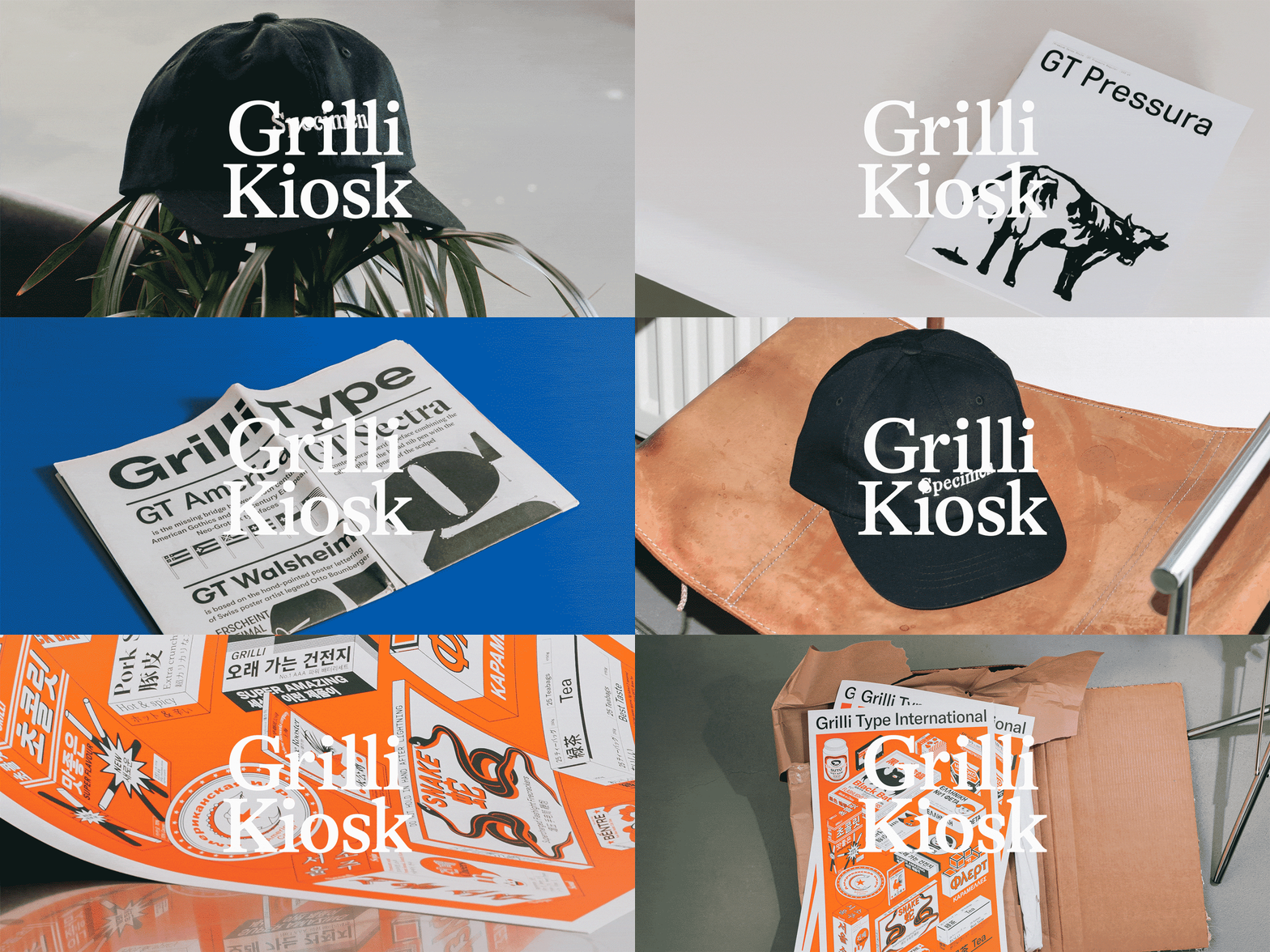
So I started emailing Grilli Type asking for feedback on my pretty average type designs. I had no idea what I was doing and they did, so I thought what could I lose?
The first round of feedback was literally telling me my work sucked and I should keep drawing. And then I would reply every few months over the year and slowly the work got better. They were asking for interns, and I think they were very intrigued by the idea of someone from New Zealand coming to Switzerland as I was their first intern. To Massey’s credit they realised that this was an amazing opportunity and said I needed to go and do this, and they created a paper for me and awarded me credits so I wouldn’t have to take a semester off.
Noël Leu and Thierry Blancpain at Grilli Type opened so many doors for me, and that experience alone gave me a lot of confidence and validation. I was suddenly being held to a very high standard, whereas before it had been more about fun.
:quality(82)/media/grilli.png)
:quality(82)/media/Noel-Leu.jpg)
:quality(82)/media/klim.png)
Yes. There have been people who have definitely believed in me and offered me opportunities along the way, but more often than not I have had to be the one to create the opportunity. For example, I recently did some teaching in Auckland with Alistair McCready and Kelvin Soh with the Tāmaki Type Club. No one invited me to do that, and I was just coming to New Zealand to hang out with my family. A lot of the time I’m creating this stuff for myself because I want to do it. You have to make your own future happen.
It really depends on the studio. We had situations at OK-RM where students would knock on the door, come in with their portfolio and ask to have an interview right then, and it would always be at the worst moment. I remember my tutors would say if you want an internship or a job you’ve got to bake a cake, get a billboard or email them every month for a year, but my attitude towards that is that you’ve got to be careful who you’re doing that with, as some people would find that really annoying.
Near the end of my degree I interviewed at Alt Group with Dean Poole and Ben Corban, and I thought the interview went quite well. At the end of the interview Dean looked me in the eye and said ‘this is the best work I’ve seen in this interviewing round’, and I’m thinking ‘I’ve got the job’. Then he asked: ‘What are your design goals in life?’ I said I really would like at some point to move over to Europe and learn the craft over there. Dean was like ‘Well, why don’t you go and do that?’
I didn’t get the job, but I think they saw in me that I wasn’t the kind of guy who was going to stay for years in the same job, and they would spend a lot of energy, money and care and love and training and then I’d fuck off and take all of that energy and give it to somebody else. It was a really big moment for me, and I was so upset at the time, but it all worked out.
:quality(82)/media/Ginto.jpg)
:quality(82)/media/GTAmerica.jpg)
:quality(82)/media/bencorban.png)
:quality(82)/media/deanpoole.png)
Yeah. I applied for three jobs in the UK and I got offers from all three of them, but decided on OK-RM. In hindsight, it was the best thing that ever happened to me, Ben and Dean saying no, as something incredible came out of it.
I worked with Oliver Knight and Rory McGrath for four years and met my wife there. It was collaborative and busy, with designers coming in from Europe and America who I followed online. I was really into Twitter at the time, too; it’s so terrible now, but back then it was amazing for networking. I was never too scared to message people on Instagram and hope they would want to catch up in person. I met Johannes Breyer from Dinamo in a pub here in London in that way.
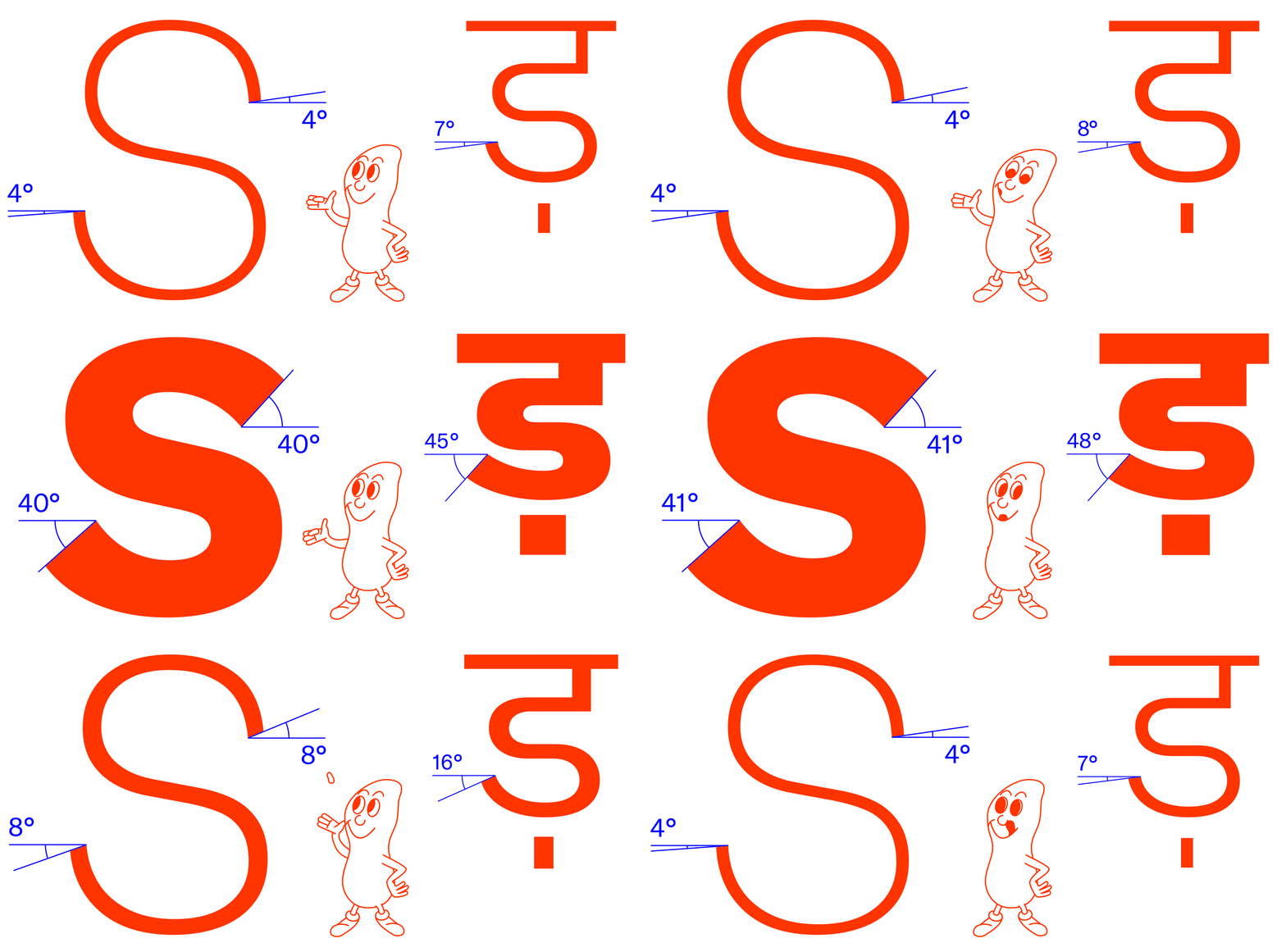
I would be drawing type all the time — nights, weekends — and I shared with him the initial sketches of what became Ginto, and he was really into it. It was perfect timing, because they had just started Dinamo and they were interested in releasing work with other people. It was life-changing. I couldn’t have got married, couldn’t have left OK-RM, got my own apartment, or paid off my student loan. Basically, so much changed because of that meeting in a pub.
:quality(82)/media/candle.jpeg)
:quality(82)/media/okrmj.png)
:quality(82)/media/oliverknight.png)
It’s also about judging the situation. I’d certainly had enough experiences with people who I knew weren’t my people. You can tell within one minute whether the body language is right, and I’ve had enough experiences reaching out to people where it didn’t work. And I knew when it did: this is someone to keep talking to; this is someone to share and continue to give energy to. Getting that job at OK-RM gave me so much confidence to be able to hit people up and connect.
For some people who maybe don’t have those anchors or pillars in their life, or that confidence, it is really difficult. I see it in some of the students who I’ve taught who aren’t so confident, and trying to get them to connect is quite hard.
:quality(82)/media/seb_theplant.jpg)
:quality(82)/media/sebamerica.png)
I have a studio in Finsbury Park that I share with a really good designer friend of mine called Christopher Lawson. He is a fantastic graphic designer and typographer, and we constantly bounce things off each other. I trust his taste so much in terms of type design, and he trusts my taste in terms of graphic design, so we help each other a lot.
My plan for the past few years has been more personal really, trying to buy a place and things like that. But I’ve got some clarity over the past few months and some new developments that should come to fruition soon.
:quality(82)/media/christopherlawson.png)
Editors note
Further Reading and Looking
christopherlawson.ltd
OKRM
Dinamo
Grilli Type